
Evidence for your setting
Local validation asks whether a technology fits the population, infrastructure and workflow in which it will be used. Supplier results are an input to that assessment.
MHRA / NHS guidanceConnect clinical, scientific and quality oversight.
Bring AI service information, accountable owners, controls, training and evidence into one shared governance environment. Give healthcare and pharmaceutical teams a clear record of how AI is used, who oversees it and what supports the next decision.
For health systems, care providers, pharmaceutical and biotech companies, and their research, manufacturing and implementation partners.

AI can arrive through a pilot, a purchased platform or a new feature in an existing system. The governance work crosses clinical practice, research, quality, procurement and operations. It needs to stay connected as the service changes.
Local validation asks whether a technology fits the population, infrastructure and workflow in which it will be used. Supplier results are an input to that assessment.
MHRA / NHS guidanceGovernance needs named responsibilities, risk review, staff education and a way to bring issues to the right decision-makers. Joint Commission/CHAI guidance sets out these connected practices.
Joint Commission / CHAI guidanceChanges in data, local conditions and the technology itself can affect performance. Monitoring and supplier updates need a route back into review and action.
MHRA / NHS monitoring guidanceExplore practical review questions for five healthcare settings. These are suggested governance approaches; the required controls depend on the function, jurisdiction and your organization’s role.
For sponsors, pharmaceutical and biotech teams, contract research organizations and manufacturing partners. Connect the AI workflow to its scientific purpose, accountable people and supporting evidence, from discovery through ongoing safety and quality work.
FDA/EMA’s good AI practice principles emphasize a defined context of use, data documentation, proportionate assessment and lifecycle management. Liquid Learn can organize the governance record around that work; scientific and regulated validation remain specialist activities. Read the joint principles.
Keep trial, safety and quality source records in approved systems. Scope any GxP (Good Practice) use with your quality team, including validation, data integrity, retention and electronic-record requirements. Review the product’s role and limits.
Use the platform to organize the governance work around each service. Your clinical, scientific, quality, privacy and regulatory specialists determine what is appropriate and carry out the underlying assurance.
An inventory name alone does not explain who uses an output or where patient, participant or research information goes.
Map people, applications, AI steps, data stores and external providers. Describe intended use and the handoffs that need review.
The record you buildA service map with scope, data classifications and accountable owners.
Your team’s part: Your team identifies and maintains the inventory; this is not automatic discovery of every AI tool.
Clinical, scientific, quality and supplier teams may each own a different part of the same workflow.
Locate human review, approval and escalation points alongside AI activity. Record the roles responsible for decisions and exceptions.
The record you buildAn oversight model showing who reviews, who acts and where the fallback belongs.
Your team’s part: Clinical and quality authority, staffing and actual stop or override controls remain with your organization.
Prompts, transcripts, outputs, logs and support access can cross different contractual and technical boundaries.
Associate data classifications and control notes with service steps and connections. Reference privacy assessments, supplier terms and security reviews.
The record you buildA reviewable account of data movement, safeguards and the documents supporting them.
Your team’s part: Contracts, access controls and retention rules must be agreed and implemented in the relevant systems.
Performance in a supplier study may not establish suitability for your patients, study data, staff or regulated process.
Bring references to local evaluations, subgroup analyses and workflow tests into the review. Retain the service version, reviewer details and comments.
The record you buildA decision record with the evidence considered, its limitations and unresolved questions.
Your team’s part: Clinical or GxP validation, bias testing and performance measurement are performed separately.
A device function, a drug-development model and an administrative agent can have different requirements.
Use configured sources, extracted obligations and profile-based matching to organize requirements with their document and version context.
The record you buildRequirements linked to source context, owners and applicability review.
Your team’s part: Specialists confirm classification and applicability; source coverage must be configured and checked.
Staff need to understand approved uses, output limitations, relevant procedures and escalation.
Target training requirements to roles or teams, set due dates and review completion, outstanding assignments and available certificates.
The record you buildLearning records that can support the service’s oversight and readiness review.
Your team’s part: Your team chooses appropriate learning and assesses competence; completion is not clinical credentialing.
A model update, new population or changed workflow can undermine the assumptions behind approval.
Keep reviewed service snapshots and evidence references available for the next assessment. Record review comments against the service being considered.
The record you buildA history that helps reviewers compare scope, supporting evidence and decisions.
Your team’s part: Teams and suppliers operate monitoring, incident response and any required regulatory reporting.
Governance owners also need to understand where activity and cost are accumulating.
Relate available metered usage and costs to responsible teams, services or business units alongside the governance record.
The record you buildOperational context to help question whether recorded use matches the agreed service scope.
Your team’s part: Usage metering does not measure clinical outcomes, detect model drift or establish patient benefit.
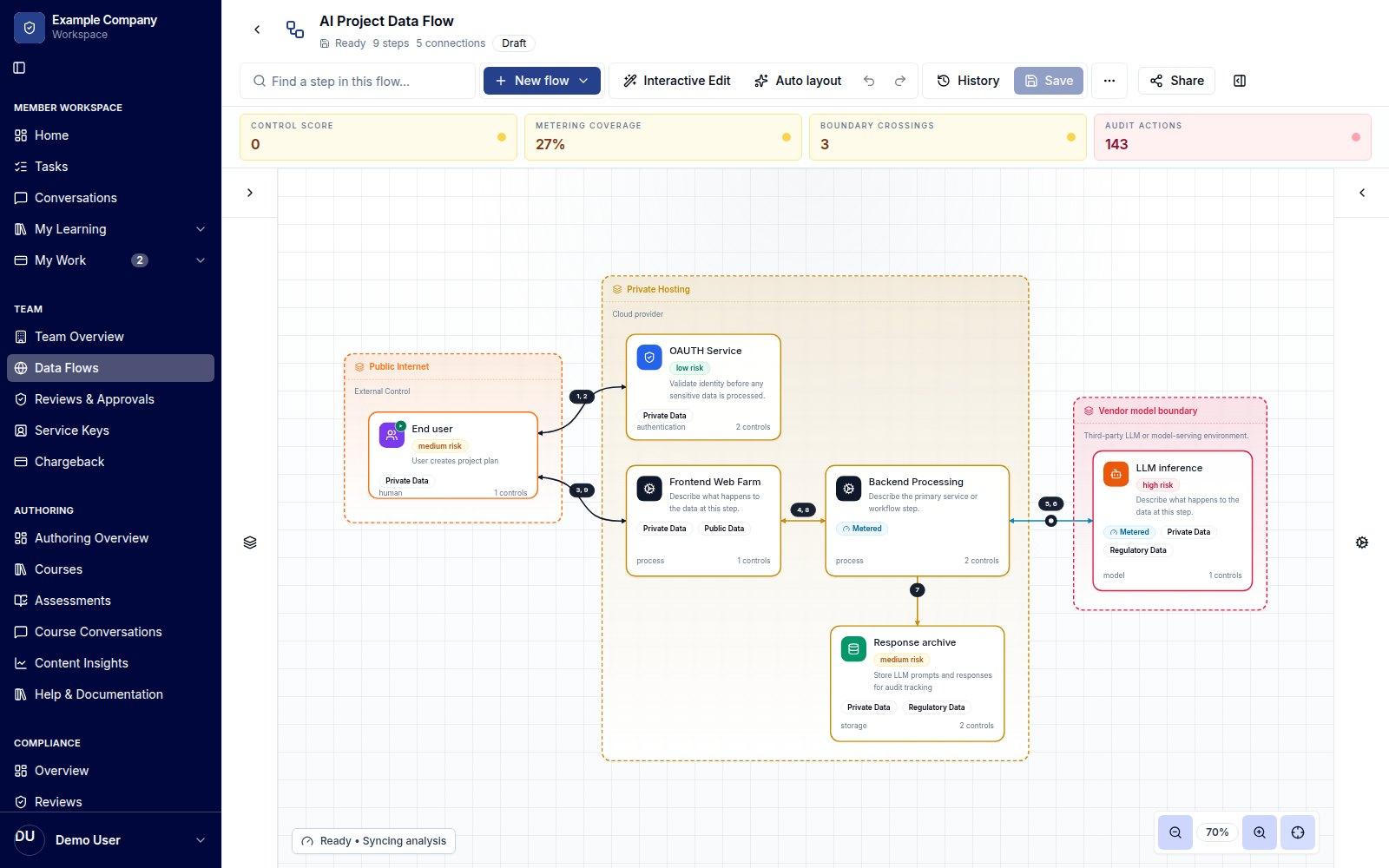
A shared service map gives reviewers context for controls, ownership and evidence. Model the healthcare workflow you need to govern, then connect its review work.
Explore the product workspace See training rollout and trackingModel the path from a consultation to a reviewed record, including the supplier boundary and the clinician’s decision. This is an illustrative governance model, not a clinical-system integration or a patient record.
Reference the communication procedure and approved recording scope.
Identify the provider, model context and retention arrangements.
Record who checks the draft and the fallback for unsuitable output.
Document the control before reviewed content enters the clinical record.
Bring evaluation references and supplier changes back to the service owner.
Reference the approved-use policy, supplier due diligence, privacy assessment, local evaluation, training records and monitoring plan. Keep source evidence in its approved system and use references that do not expose patient information.
Revisit the mapped scope and prior review with the clinical owner, digital team and relevant specialists. Record the evidence considered, remaining questions and decision against the service version.
For use in England, NHS guidance emphasizes approved tools, patient transparency and checking generated notes before they enter the record. Read the ambient scribe guidance
Care delivery and medicines development have distinct regulatory contexts. A healthcare setting does not make every AI use a medical device. Use the starting points below for clinical services and the pharma-specific references for drug and biologic work.
FDA’s January 2026 final CDS guidance addresses function-specific device exclusions. HIPAA cloud arrangements require attention to business-associate status, agreements and risk analysis where applicable.
The HTI-5 final rule changes relevant DSI certification requirements on December 28, 2026. These certification rules do not cover every hospital AI tool; retain appropriate supplier evidence commitments through the transition.
Read the medical AI guideNHS adopter guidance distinguishes DCB0129 for developers and DCB0160 for deploying organizations. Clinical risk management needs competent people, evidence and attention through the lifecycle.
Bring references to clinical safety and data protection work into your service review. Required safety documentation, assessments and sign-off remain specialist responsibilities.
Explore the UK contextAssess provider and deployer roles, intended use and any medical-device overlap. Keep data protection and existing device duties in scope alongside the AI Act.
The July 2026 amendment moves Annex III high-risk rules to December 2, 2027 and the Annex I route to August 2, 2028. A later deadline for one provision does not postpone every obligation.
Explore the EU AI Act guideSources reviewed . Educational context, not legal advice. The mappings on this page are suggested operating practices; using Liquid Learn does not certify compliance. How we review sources.
Our guides bring together official sources, scope questions and practical governance records. Explore medical AI for care delivery and the FDA/EMA references below for pharmaceutical work.
Function-level scope, FDA guidance, clinical oversight, health data and the HTI-5 transition.
Read the guide Patient-facing interactionsReview disclosures, human handoffs and jurisdiction-specific safeguards for conversational services.
Read the guide European UnionProvider and deployer roles, the amended timetable and the requirements that need applicability review.
Read the guide United KingdomData protection, significant automated decisions and accountability in the UK context.
Read the guide United StatesFederal and state layers, consequential decisions and the importance of scope and exceptions.
Read the guide Workforce readinessUS public-sector programs and a practical rollout approach. Program eligibility and recognition vary.
Read the guideA shared FDA/EMA reference for context of use, data governance, proportionate performance assessment and lifecycle management.
Read the official source Draft guidance · January 2025FDA’s proposed model-credibility framework for AI supporting drug and biologic regulatory decisions. Still draft at this review; not for implementation.
Read the official source Reflection paper · September 2024 · PDFEMA’s considerations across discovery, development, manufacturing and post-authorization. Read alongside applicable medicines and quality requirements.
Read the official sourceThe 24-question AI Governance Health Check offers an immediate result and downloadable PDF roadmap. Use it to start a discussion; it is a general maturity assessment, not a clinical safety assessment.
Start with synthetic examples and evidence references that do not expose patient information. PHI handling, contractual terms including any BAA, deployment security and suitability must be confirmed separately before considering patient-data use. This page does not establish HIPAA suitability or authorization to store PHI.
Liquid Learn organizes service governance, controls and review evidence. Your specialists perform clinical validation, determine device status and maintain required clinical safety and quality-system processes. The platform does not provide medical-device authorization, clinical decision-making or automatic compliance certification.
Liquid Learn supports governance around AI workflows. It is not presented here as a validated GxP system, electronic trial master file, pharmacovigilance database or batch-release system. Any regulated use needs a separate suitability and validation assessment by your quality team. This page does not establish compliance with 21 CFR Part 11 or EU GMP Annex 11. Required audit trails, electronic signatures, record retention and source-system controls must be evaluated separately.
Service mapping describes systems and their boundaries; it does not imply a live EHR, FHIR or medical-device integration. Any integration must be scoped and confirmed. Clinical outcome measurement, drift detection and safety monitoring operate in the appropriate clinical and technical systems; their evidence can inform governance reviews.
Explore a delivery approach with your governance advisers or system integrator. Agree the scope, responsibilities, access and commercial arrangements for your organization. Learn about Liquid Learn partnerships.
Tell us what AI is doing, which team owns it and what your next review needs to establish. We’ll explore how service mapping, controls, evidence and training tracking could fit your workflow.
A clinical, scientific or process owner, a digital lead and a colleague from quality, privacy or governance.
The intended use, supplier dependencies and current review process. Please use a description without patient or trial-participant details, confidential research or other sensitive information.